<html><!-- #BeginTemplate "/Templates/articles.dwt" -->

<head>
<!-- #BeginEditable "doctitle" -->
<title>About Orthoseek</title>
<!-- #EndEditable --> 
<script language="JavaScript">
<!--
function MM_swapImgRestore() { //v3.0
  var i,x,a=document.MM_sr; for(i=0;a&&i<a.length&&(x=a[i])&&x.oSrc;i++) x.src=x.oSrc;
}

function MM_preloadImages() { //v3.0
  var d=document; if(d.images){ if(!d.MM_p) d.MM_p=new Array();
    var i,j=d.MM_p.length,a=MM_preloadImages.arguments; for(i=0; i<a.length; i++)
    if (a[i].indexOf("#")!=0){ d.MM_p[j]=new Image; d.MM_p[j++].src=a[i];}}
}

function MM_findObj(n, d) { //v3.0
  var p,i,x;  if(!d) d=document; if((p=n.indexOf("?"))>0&&parent.frames.length) {
    d=parent.frames[n.substring(p+1)].document; n=n.substring(0,p);}
  if(!(x=d[n])&&d.all) x=d.all[n]; for (i=0;!x&&i<d.forms.length;i++) x=d.forms[i][n];
  for(i=0;!x&&d.layers&&i<d.layers.length;i++) x=MM_findObj(n,d.layers[i].document); return x;
}

function MM_swapImage() { //v3.0
  var i,j=0,x,a=MM_swapImage.arguments; document.MM_sr=new Array; for(i=0;i<(a.length-2);i+=3)
   if ((x=MM_findObj(a[i]))!=null){document.MM_sr[j++]=x; if(!x.oSrc) x.oSrc=x.src; x.src=a[i+2];}
}
//-->
</script>
<link rel="stylesheet" href="../Templates/style1.css">
</head>

<body bgcolor=#FFFFCC onLoad="MM_preloadImages('../img/menu/navbar_r1_c1_f2.gif','../img/menu/navbar_r1_c3_f2.gif','../img/menu/navbar_r1_c5_f2.gif')">
<table width=80% border=0 cellpadding=0 align=center cellspacing="0">
  <tr valign="bottom"> 
    <td><a href="../index.html"><img src="../img/ostree_small.gif" width="120" height="120" align="left" hspace="2" border="0" vspace="5" alt="home"></a> 
      <table width="75%" border="0" cellpadding="0" cellspacing="0" align="right">
        <tr> 
          <td><img src="../img/dot_333333.gif" width="380" height="1" align="right"></td>
        </tr>
        <tr> 
          <td> 
            <table border="0" cellpadding="0" cellspacing="0" width="380" align="right">
              <!-- fwtable fwsrc="menu2.png" fwbase="navbar.gif" --> 
              <tr valign="top"><!-- row 1 --> 
                <td> 
                  <table border="0" cellpadding="0" cellspacing="0" width="64">
                    <tr valign="top"><!-- row 1 --> 
                      <td><a href="../aboutus.html" onMouseOut="MM_swapImgRestore()"  onMouseOver="MM_swapImage('navbar_r1_c111','','../img/menu/navbar_r1_c1_f2.gif',1)" ><img name="navbar_r1_c111" src="../img/menu/navbar_r1_c1.gif" width="64" height="17" border="0" alt="about us"></a></td>
                    </tr>
                    <tr valign="top"><!-- row 2 --> 
                      <td><img name="navbar_r2_c1" src="../img/menu/navbar_r2_c1.gif" width="64" height="4" border="0"></td>
                    </tr>
                  </table>
                </td>
                <td><img name="navbar_r1_c2" src="../img/menu/navbar_r1_c2.gif" width="39" height="21" border="0"></td>
                <td><a href="../topics.html" onMouseOut="MM_swapImgRestore()"  onMouseOver="MM_swapImage('navbar_r1_c311','','../img/menu/navbar_r1_c3_f2.gif',1)" ><img name="navbar_r1_c311" src="../img/menu/navbar_r1_c3.gif" width="128" height="21" border="0" alt="orthopedic topics"></a></td>
                <td><img name="navbar_r1_c4" src="../img/menu/navbar_r1_c4.gif" width="41" height="21" border="0"></td>
                <td><a href="../disclaimer.html" onMouseOut="MM_swapImgRestore()"  onMouseOver="MM_swapImage('navbar_r1_c511','','../img/menu/navbar_r1_c5_f2.gif',1)" ><img name="navbar_r1_c511" src="../img/menu/navbar_r1_c5.gif" width="108" height="21" border="0" alt="message forum"></a></td>
              </tr>
            </table>
          </td>
        </tr>
        <tr> 
          <td><img src="../img/dot_333333.gif" width="380" height="2" align="right"></td>
        </tr>
      </table>
      <p>&nbsp;</p>
      <p><a href="../topics.html"><img src="../img/title_topics.gif" width="225" height="40" align="right" hspace="10" border="0" alt="orthopedic topics"></a></p>
      <p>&nbsp;</p>
      <h2><!-- #BeginEditable "title" -->
      <h2>Fractures</h2>
      <!-- #EndEditable --></h2>
    </td>
  </tr>
  <tr> 
    <td><!-- #BeginEditable "content" -->A fracture is a break in the bone. There
      are many descriptive terms appended to a fracture, and often a source of
      confusion to the layman. This is an attempt to clarify the common terms
      used.
      <p>A fracture can be described by its appearance on X-rays. In a long bone
        of any limb (where most fractures occur), a <a name=trans><i>transverse
        fracture</i></a> occurs when the fracture line is transverse across the
        shaft of the bone (perpendicular to the long axis of the bone) - usually
        a result of a bending injury. An <a name=obl><i>oblique fracture</i></a>
        occurs when the fracture line is oblique across the shaft of the bone
        -usually a result of a combination bending and twisting injury. A <a name=spiral><i>spiral
        fracture</i></a> occurs when the fracture line spirals around the shaft
        of the bone - a result of a pure twisting injury. A <a name=comm><i>comminuted
        fracture</i></a> occurs when the bone is broken into more than two fragments.
      <center>
        <p><img src=img/fractures1.gif> 
      </center>
      <p>If the fracture fragments are in good position, the fracture is called
        an <a name=undis><i>undisplaced fracture</i></a>. Sometimes the fracture
        line is so fine that it is called a <a name=hair><i>hairline fracture</i></a>.
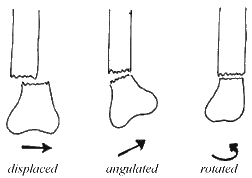
        If there is displacement of the fracture fragments, it is called a <a name=disp><i>displaced
        fracture</i></a>. A displaced fracture may axially displaced, angulated
        or rotated.
      <center>
        <p><img src=img/fractures2.gif align=top> 
      </center>
      <p>With severe trauma, there may be disruption of the muscles and skin,
        causing the fracture to communicate with the external environment - an
        <a name=open><i>open or compound fracture</i></a>. Most fractures do not
        communicate with the external environment because the skin is not broken
        - a <a name=closed><i>closed fracture</i></a>.
      <p>There are also special circumstance fractures.
      <ul>
        <li>A <a name=stress><i>stress fracture</i></a> occurs when a bone is
          subject to repeated stress, e.g., from running or marching. This is
          also called a <a name=fati><i>fatigue fracture</i></a>.
        <li>A <a name=path></a><i>pathological fracture</i> occurs when minor
          stress is placed upon a bone that is weakened by pre-existing disease,
          e.g., bone affected by osteoporosis, or a bone cyst, or cancer cells.
        <li>An <a name=avul><i>avulsion fracture</i></a> occurs when a muscle-tendon
          unit exerts such traction force on the bone it is attached to, that
          it avulses off a piece of bone. This is more frequent in children and
          adolescents where the muscle-tendon unit is stronger than the bone.
          It happens typically around the hip and knee.
        <li>A <a name=green><i>greenstick fracture</i></a> occurs only in children,
          because of the increased elasticity of young bones. The fracture is
          an <a name=incom><i>incomplete fracture</i></a> that goes partly through
          the bone, leaving part of the cortex and periosteum (covering) of the
          bone intact. It is comparable to trying to break a young green twig.
          It tends to bend and break partially, rather than snap, as in a dry
          twig (like an old bone). If a compressive force is applied on a child's
          bone, e.g., when he falls on the outstretched hand, it buckles the bone
          just above the wrist, giving an expanded appearance on X-rays. This
          is a type of greenstick fracture, called a <a name=buckle><i>buckle
          fracture</i></a> or <a name=torus><i>torus fracture</i></a>.
        <li>An <a href=epiphyseal.html>epiphyseal injury</a> (or fracture) occurs
          at the epiphyseal plate or growth plate at the ends of the long bones,
          that happens in children and adolescents. They are sometimes called
          <a href=epiphyseal.html#salter name=salter></a><i>Salter fractures</i>,
          because Dr. Robert Salter from Toronto first classified these injuries.
          <p></p>
      </ul>
      <!-- #EndEditable --> 
    </td>
  </tr>
  <tr align="left"> 
    <td> 
      <p> 
      <p>&nbsp;</p>
      <p><font size="-1"><i>NOTICE: The information presented is for your information 
        only, and not a substitute for the medical advice of a qualified physician. 
        Neither the author nor the publisher will be responsible for any harm 
        or injury resulting from interpretations of the materials in this article.</i></font></p>
      <p><b>Questions or comments? Post your thoughts in the <a href="../disclaimer.html">Orthoseek 
        Message Forum!</a> <br>
        </b><b><a href="../links/referral_fs.html">Find</a> a pediatric orthopedic 
        surgeon in an area near you. </b> </p>
      <p>
      <p>
      <p>
      <p>
      <hr>
    </td>
  </tr>
  <tr> 
    <td align="center"> 
      <p><font size=-2><a href="../index.html">Home</a> | <a href="../aboutus.html">About 
        Us</a> | <a

href="../topics.html">Orthopaedic Topics</a> | <a href="../disclaimer.html">Message 
        Forum</a></font> <br>
      <p> <img src=../img/wbcfooter.gif alt="Copyright (c) 2003 Wheaton Resource Corp." width="500" height="20"><br>
        <font size=-2>Comments, questions, or suggestions are welcome. Please 
        contact us using <a href="../contact.html">this form</a>.</font> 
    </td>
  </tr>
</table>

</body>

<!-- #EndTemplate --></html>



